Features

What runs in the current build, what is being built now and what is planned, sorted by what you do in the game.

What runs in the current build, what is being built now and what is planned.

30 / 36Built

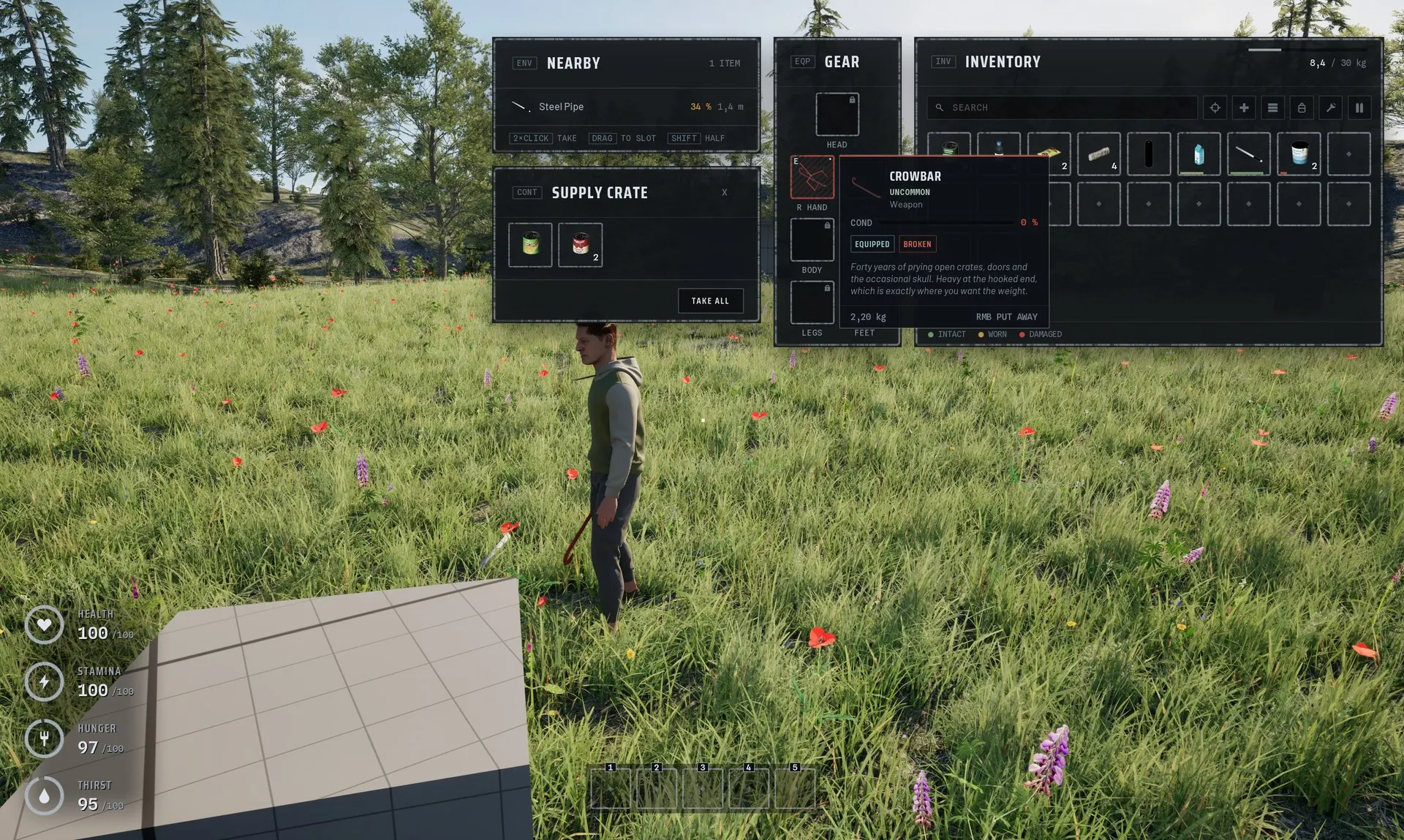
The survivor stands in a meadow next to a grey crate; at the top the open panels Nearby, Supply Crate, Gear and Inventory, a tooltip shows a broken crowbar at 0 percent condition.

Looting

6 / 6 built
  • A backpack, not a warehouseBuilt

    Every item has weight. Carry too much and you slow down. You arrange the slots yourself; search and filters help you find things, stacks can be split.

    Devlog #1: Inventory and looting →
  • Loot fast when it gets tightBuilt

    Search crates, cupboards and the infected you put down: it takes a couple of seconds, and until you have looked you do not know whether anything is in there at all. Pick items off the ground, drag loot into your inventory and it finds the right slot. Several players can loot the same crate at once without items being duplicated. What you find depends on the place: houses, forests, vehicles, military, police and medical spots each have their own loot, rarer things turn up less often, and looted spots slowly fill up again while nobody is around.

    Devlog #10: Scavenging →
  • What you wear is what you carryBuilt

    Your pockets come from your clothes: a hoodie has two, cargo trousers six, and you see what is in which. A backpack adds eight, sixteen or twenty-four slots and lets you carry more weight. A piece with something in its pockets fits into no slot: drop it and it lies on the ground with everything still in it, for you or anyone else to search or put back on. Hoodies, trousers, shoes, three backpacks and a miner's helmet are found as loot, and others see what you wear.

    Devlog #14: What you wear is what you carry →
  • HotbarBuilt

    Five quick slots for the essentials, assigned by drag and drop, used with 1–5.

  • Scavenger interfaceBuilt

    A calm, dark interface that shows condition and rarity at a glance, with vitals as ring gauges at the edge of the screen. They also show how deep you are into dehydration or starvation. A small hint next to the crosshair names whatever you are looking at and the key to use it.

  • Item condition and wearBuilt

    Weapons wear down with every blow and hit only half as hard once they break. Fresh food spoils over time, wherever it lies, and eating it spoiled makes you sick. Condition shows on every item and stays with it, whether it lies on the ground, in a crate or in your hands.

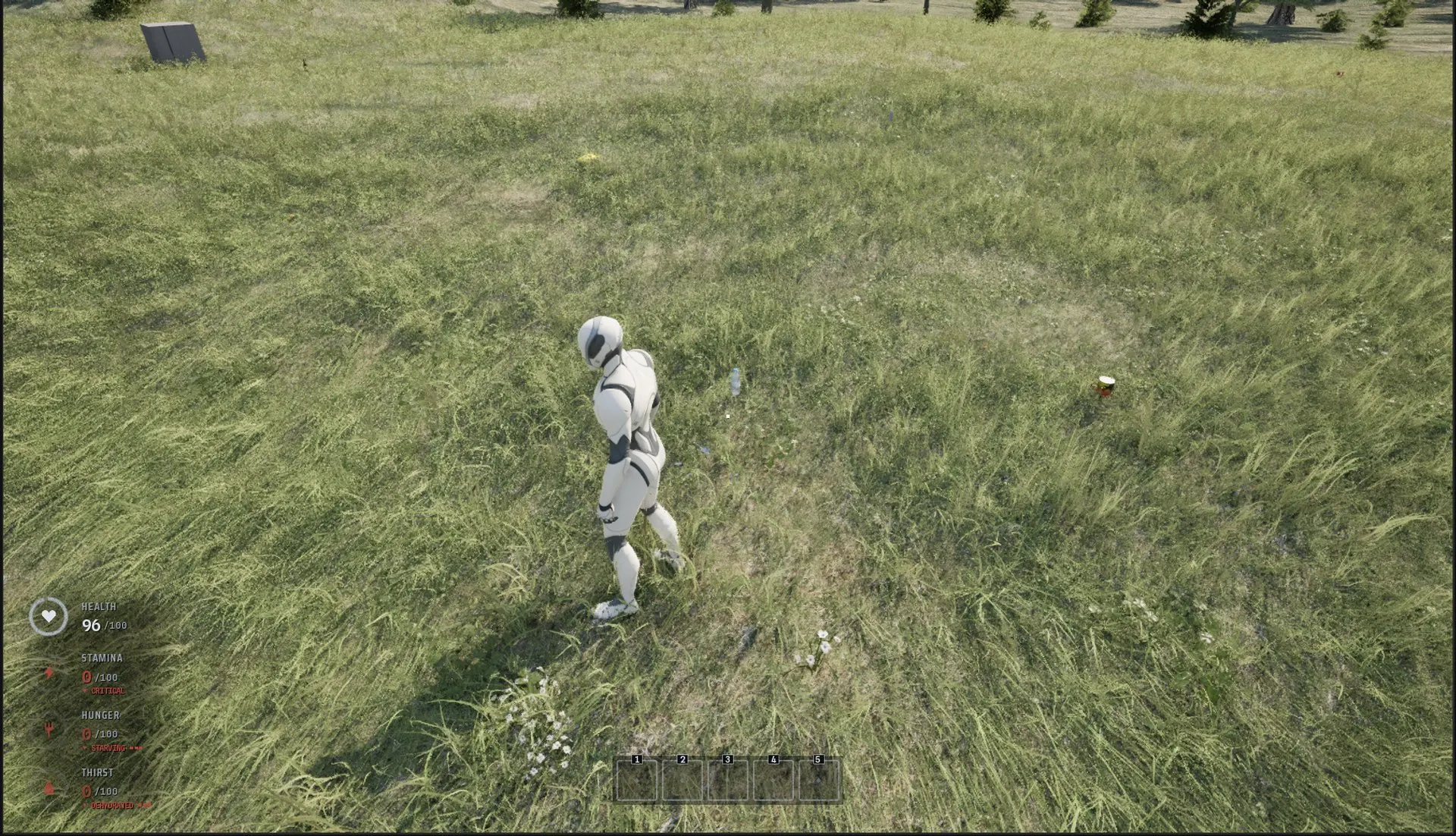
Player in a meadow; in the bottom left, the stamina, hunger and thirst readouts are red at 0, with the tags “Starving” and “Dehydrated”.

Surviving

11 / 11 built
  • Survival is budgetingBuilt

    Hunger and thirst drain steadily, and sprinting burns through both faster. Run dry and it gets worse in stages: dehydrated, your stamina recovers slower, then you can no longer run, then you start losing health. Starving cuts your stamina, stops your healing, then hurts you too. Eat or drink and the stages reset at once. You only heal when you are fed and watered.

  • Water you have to make safeBuilt

    A bottle is worth keeping: you drink it in four gulps and the empty bottle stays with you. Fill it at a river, a lake or even a puddle, but what you get is dirty and may make you sick. Boil it in the fire first. Out of cooked venison, salt and clean water you make jerky that keeps and a hot stew, and every tin you eat leaves an empty can behind: a pot for the next stew, or a bit of scrap.

    Devlog #17: Would you drink that? →
  • Wounds and infectionBuilt

    A blow from the infected can open a wound. A light one stops by itself, a heavy one bleeds until you dress it, and dressing it takes four seconds you have to stand still for. Enough hits and the wound turns into an infection: first fever, then weakness, in the end it kills you, over hours of play. Antibiotics cure it, iodine and clean dressings only hold it back, and a dirty rag makes it worse. Whoever bleeds leaves drops on the ground.

  • Something you ateBuilt

    Raw meat, river water and food gone bad can give you food poisoning. It hits a minute later: first you are thirsty all the time, then, if it gets worse, you throw up every few minutes, losing water and food, and everything nearby hears it. It passes on its own, antibiotics end it at once. Saline settles the stomach, and first aid kits heal you slowly instead of all at once. Low on breath or blood, you hear your own body.

  • Cold and wetBuilt

    The region is cold in late autumn, and colder at night. Rain soaks you unless something is over your head or your clothes keep it off, and so does wading or swimming. Wet clothes keep you less warm. Get too cold and you burn food faster, then you shiver and stop healing, in the end it kills you. A roof and walls, a torch, moving and above all a campfire warm you up and dry you; warmer clothes and a rain jacket can be found. A fire in the dark can also be seen from far away. You stock a campfire's woodpile and it feeds itself one piece at a time; a cold pit needs sticks or rags to catch, and burnt-out logs leave charcoal.

  • Berries by the pathBuilt

    Raspberry, blackberry and blueberry bushes grow in the open and at the edge of the forest. Pick a handful in passing, even at a run, or stand and eat straight from the bush. Berries are a little food and a little water, not a meal, and they do not keep for long. A bush picked bare grows back after a while, once nobody is standing around it. Stones lie in small patches by the stream and can be searched out of rocky slopes, sticks snap off bushes and dead branches lie under the trees.

  • Every action has a soundBuilt

    Going through your pockets, rummaging through a crate, cracking open a can and drinking it: every action has its own sound, and the item decides what it sounds like. Your footsteps change with the ground under you, from grass and leaves to gravel, wood, metal, snow and water, kick up dust, mud or snow, and grow louder the faster you move; a hard landing is heard. Players nearby hear you walk, loot, drop and use things, so careful also means quiet.

  • Torch and flashlightBuilt

    Carry a light in your left hand and the dark gets smaller, and you get easier to see. A torch is quick to craft, lights all around you and burns out in minutes, faster out in the rain. A flashlight has to be found and needs batteries, but its narrow beam gives you away only to what it points at. Stick a torch in the ground to light a camp, or to draw the infected somewhere you are not. Nothing on screen says how long a light will last: the lamp starts to flicker, the flame gets smaller.

  • A survivor, not a mannequinBuilt

    You play a realistic person: a weathered survivor in a hoodie and cargo trousers. Every step is picked from motion-captured movement as you go, so starts, sudden stops, sharp turns and the lean into a curve look like a person moving, not a puppet. You see what you do: the bottle goes to your mouth while you keep walking, you bend down for what lies on the ground and reach into the crate you loot. For now every survivor has the same face and body and only their gear differs; choosing your own face comes later.

    Devlog #8: Moving like a person →
  • Walk, jog or run for itBuilt

    You jog by default. Toggle to a walk and your steps go quiet, which matters when the dead listen. Sprint and you outrun them, as long as your stamina lasts. A jogger gets caught.

  • Death and what you leave behindBuilt

    When you die, everything you carried stays where you fell, in a bag anyone can search for 30 minutes. You start over with almost nothing: two cloth strips, half a bottle of water and an energy bar. Where is up to you: a random place, or your sleeping bag if you laid one out at your base.

    Devlog #12: What you leave behind →
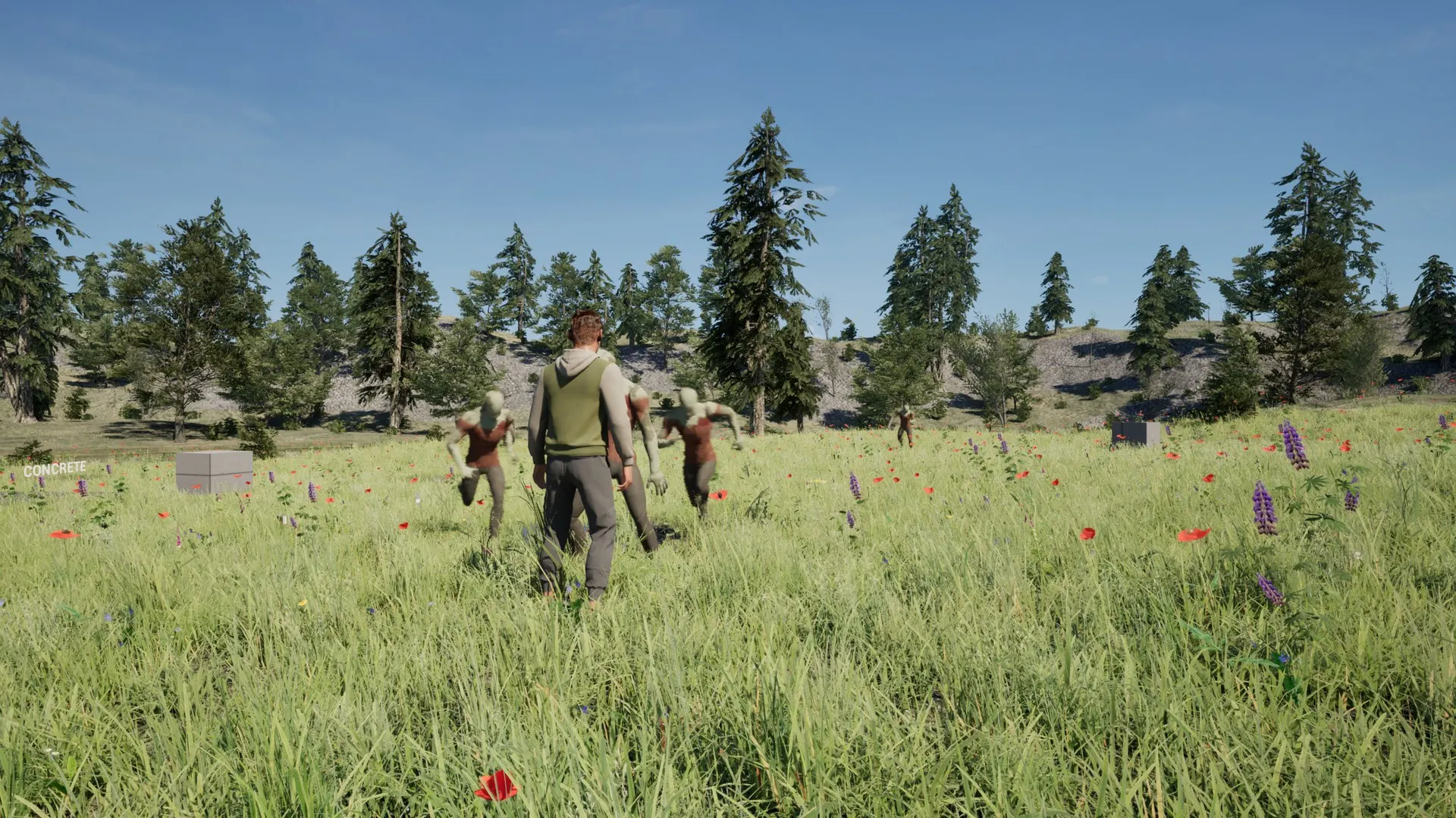
Seen from behind, the survivor stands in a meadow with poppies while three pale, blood-stained infected run at him across the grass; pines and a rocky hill behind.

Encounters

6 / 8 built
  • The infectedBuilt

    The infected shamble through the land, each in its own gait, until they notice you. Then some stop to roar, and all of them run. They see far by day and little at night, in fog or in rain, and they listen: a sprint, a hard landing or a clattering can carries much farther than a careful step, while rain and wind cover your noise. Break their line of sight and they search where they last saw or heard you. They cannot swim: get into deep water and they pace the shore, then give up and wander off. A swing can be dodged by stepping back. Shut yourself in and they beat on the door or wall between you and them until it gives.

    Devlog #7: The infected →
  • Fight back up closeBuilt

    When they get close, you hit back: with your fists, or with whatever heavy you found, a crowbar or a length of steel pipe. You take a weapon in your hand by placing it in your gear, and others see you carry it. Every swing costs stamina and needs a moment to wind up, so timing matters. A solid hit knocks the infected back and stuns it for a moment, interrupting its own attack, but it will come for you. Swings and hits make noise. Standing, your whole body goes into the blow; on the move only your arms do.

    Devlog #9: Fight back →
  • Something for a distanceIn progress

    The first ranged weapon is a bow you tie together from sticks and cloth, with arrows of stone or scrap. Hold the right mouse button to draw and aim over the shoulder, click to loose. Arrows fly a real arc and drop with distance; a full draw to the head puts an infected down. Hold it too long and your arms start to shake. The shot is nearly silent. Arrows stick where they land and can be picked up again, unless they break.

    Devlog #16: Something to hunt →
  • Crouch and crawlBuilt

    Crouch to sneak or lie flat in the grass and crawl. Low, your steps are quieter and the infected have to come a lot closer to spot you; crawling is close to silent. Lying down and getting up take a moment, and a light in your hand still gives you away.

  • Say it out loudBuilt

    Hold a key and talk to whoever stands near you. Your voice comes from your character, fades out over about forty metres and turns dull behind a wall. Nothing tells you who is talking, only from where. The infected hear you too, a little farther than a walking step.

  • GesturesBuilt

    No microphone, or nothing you want to say out loud: hold a key for a wheel and wave, raise your hands, call someone over, wave them off, point, or give a thumbs up. It works on the move, and whatever you carry in your hand stays in view.

  • Menus and settingsBuilt

    A main menu with see-through panels behind which a survivor keeps watch at a camp fire, live and with its own music, a pause menu that leaves the world in view, and one settings page for both: volumes for voices, game sounds, ambience and music, window and quality, your own keys. Nothing counts until you apply it. Brightness cannot go past neutral on a PvP world, so nobody gets night vision from a slider. An upscaler (Unreal's TSR, or NVIDIA DLSS on RTX cards), NVIDIA Reflex, a frame rate counter and the size of the HUD are in the settings too. Choosing a microphone is not in yet.

  • Co-op and community serversIn progress

    Co-op works: host a world from the main menu for up to eight players, with or without PvP, and friends join you by address. The host's game decides everything, against cheating from the start. Joining through your friends list and community servers with up to 32 players come later; the dedicated server already runs and has been tested with 32 bots.

    Devlog #11: Bring a friend, and the world remembers →
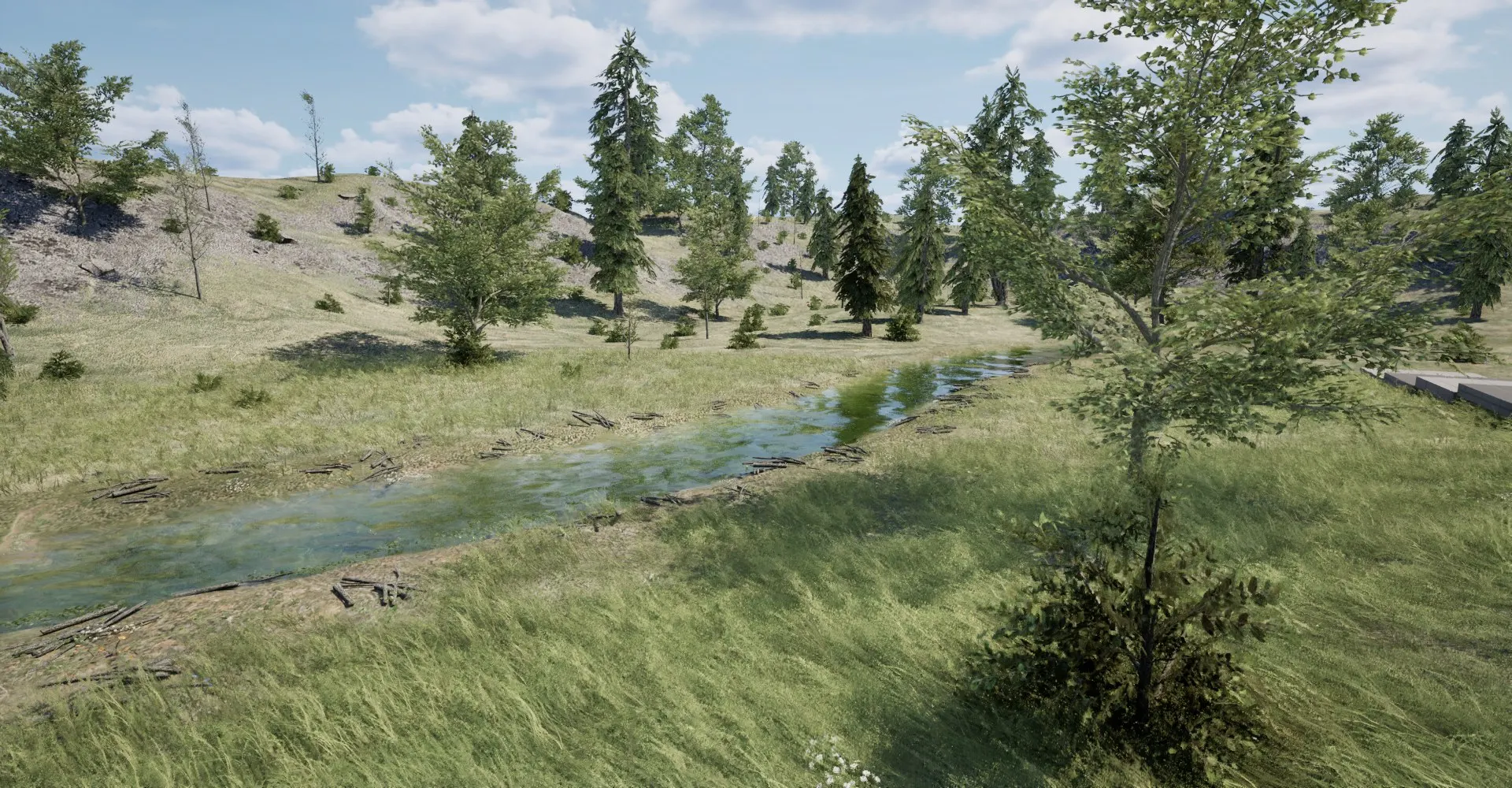
A shallow, greenish river winds through a grassy meadow, its muddy banks scattered with fallen twigs; birches and pines on the hills behind.

Exploring

5 / 9 built
  • Day and nightBuilt

    A full day-night cycle. Nights are genuinely dark: without a light you see little more than shapes, and the interface is often the brightest thing on screen.

    Devlog #2: A place to stand →
  • Rivers, lakes and puddlesBuilt

    A murky river winds through the meadow into a small lake, both cut into the land, and rain has left puddles in the grass. Wade in and the water holds you back: the deeper it gets, the slower you walk and the faster a sprint wears you out, and every step splashes or sloshes. Where your feet lose the ground you swim, and you only catch your breath again on land. Drinking from it is not in yet.

    Devlog #5: Out of your depth →
  • Weather that turns on youBuilt

    The weather changes on its own: clear skies, clouds, thick fog, rain from drizzle to downpour, storms and thunderstorms. Bad weather turns the world dark and grey, the wind bends grass and trees, rain drops ripple the lake, the river and every puddle, and in a thunderstorm lightning strikes around you, its thunder arriving seconds later depending on how far away it hit. Everyone in a world shares the same sky and the same lightning.

    Devlog #6: Weather that turns on you →
  • A world you can hearBuilt

    Birds sing by day and crickets at night, and both fall silent when it rains or the wind picks up. The wind roars louder among the trees, rain patters, swells and drums. Step into a hut and the storm outside turns into a muffled roar while the rain hammers on the roof.

  • Something to huntIn progress

    Red deer graze in the meadows and bolt as a herd when they see or hear you. Hit one and it runs, leaving a blood trail to follow. Skin the carcass with a stone knife for meat, hide and bones, and roast the meat on a spit over the campfire, where you can see it go from raw to done to burnt; done pieces come off onto a rest beside the fire. Crows sit in the treetops and rise in a noisy flock when someone comes near or makes a racket - you, or something else. Foxes slip away at night, and now and then a wolf pack finds you: they circle, growl and dart in one at a time. A torch or a campfire keeps them off. At dusk you often hear them before you see them.

  • A world that remembersBuilt

    A world survives being shut down. Survivors keep where they stood, their vitals and everything they carry; crates keep their contents, dropped items stay where they lie, and the time of day goes on where it stopped. Worlds are saved regularly and keep backups, and servers can wipe on a schedule.

  • VehiclesPlanned

    Drivable vehicles with real driving physics.

  • A region that growsPlanned

    A compact, dense region of villages, farms, forests and small towns, where nearly every house can be entered. It is meant to open up further over time, along roads and rivers that already lead beyond its edge.

  • QuestsPlanned

    Tasks that lead you through the world and tell its story.

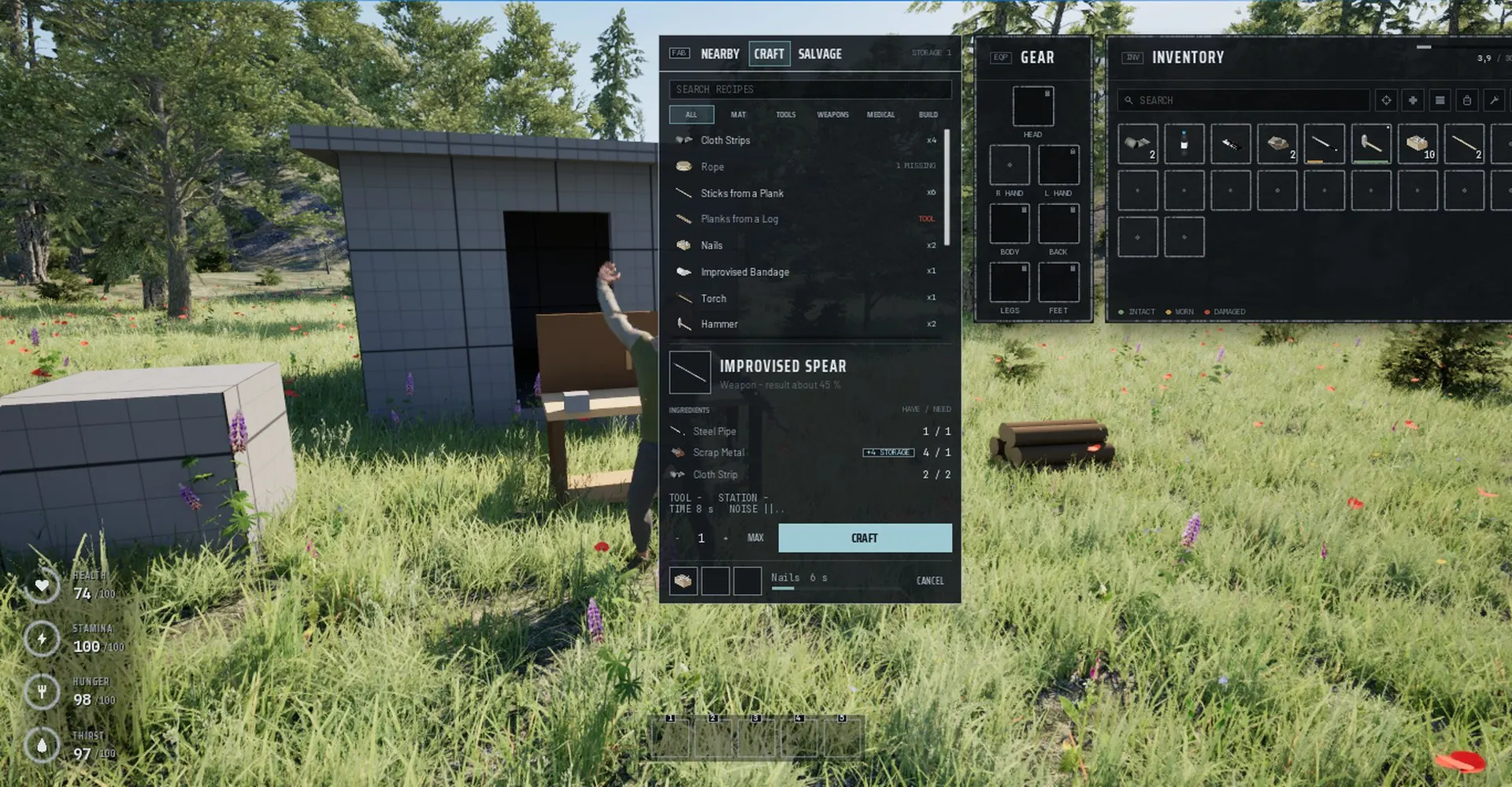
A survivor raises a hammer at a wooden workbench next to a grey hut, a log pile in the grass; the crafting panel with recipes and the improvised spear selected is open beside the gear and inventory panels.

Crafting

1 / 1 built
  • Make what you cannot findBuilt

    Craft tools, weapons, bandages and the parts for a base from what you carry and from your storage crate nearby. Some things need a tool or a workbench, crafting takes time and the hammering is loud. Jobs at a workbench or a campfire keep running in the station after you walk away, and anyone with access to your base can stock it, queue on it or take out what is done. Wood comes from log piles, plank heaps and furniture you break up; old things can be taken apart for their materials.

    Devlog #13: Making things →
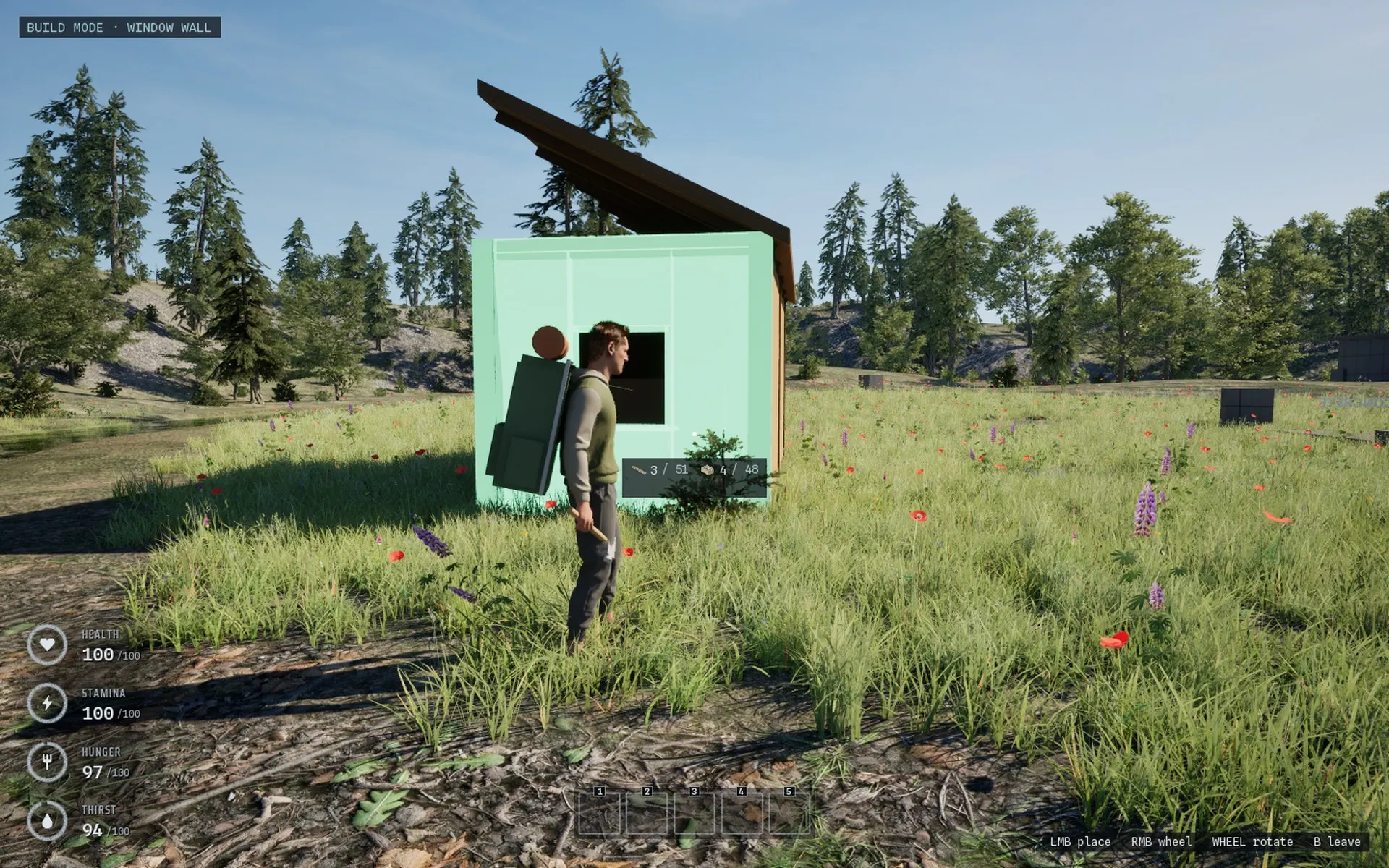
A survivor with a hammer stands before the open end of a small wooden hut. A translucent green wall with a window hangs there, its cost under the crosshair.

Base building

1 / 1 built
  • Base buildingBuilt

    Foundations, walls, door frames, doors, windows, ceilings, stairs and roofs snap together on one grid and cost planks and nails, from what you carry or from your crates nearby. Doors take a code lock or a key lock, and whoever opens one has access to the base. Crates can be locked too, each with its own code or key. The infected break through what stands in their way. A hammer repairs, what loses its foundation falls, and a base nobody visits slowly rots away. A sleeping bag lets you wake up there after you die. All of it survives a restart.

    Devlog #15: The first night together →